Starting a business in India in 2026 can take many forms, from providing digital services to solving practical problems related to food, waste, education, energy, tourism, and online commerce. A strong business idea should solve a genuine customer problem rather than simply follow a temporary trend.
India already has a large small-business ecosystem. The Ministry of MSME’s 2024–25 Annual Report recorded 3,24,47,750 MSMEs registered through Udyam as of December 31, 2024, including 3,16,45,955 micro enterprises.
Government initiatives also identify several areas where entrepreneurs can develop solutions. Startup India’s Idea Bank highlights challenges involving food waste, quality education, pollution control, waste management, water resources, financial inclusion, skilled workers, energy, and animal welfare.
This makes it useful to look beyond conventional businesses when considering the 12 Unique Business Ideas in India for 2026. The ideas below are not presented as guaranteed-profit opportunities. Their suitability depends on customer demand, location, skills, competition, regulations, and available resources.
What Should You Consider Before Starting a Business in India?
Before selecting one of these 12 Unique Business Ideas in India, evaluate whether the business actually fits your skills, budget, market, and legal requirements.
Market Demand
A business should begin with a customer problem or requirement that you can clearly identify. Startup India’s Idea Bank uses this problem-solving approach, encouraging entrepreneurs to look at challenges facing India and develop possible solutions.
Instead of assuming that a product will sell, research potential customers in your target area. Talk to customers, study competitors, compare prices, and identify what existing businesses do well or where customers experience problems.
Starting Capital
Your available capital affects which business model is realistic. A service business such as digital marketing or tutoring may require different resources from a physical operation involving food production, recycling, or solar equipment. Avoid choosing an idea simply because another website describes it as a “low-investment” opportunity.
Calculate equipment, rent, software, inventory, transportation, marketing, employee costs, taxes, registration expenses, and working capital before committing money.
Required Skills
Your existing skills can influence how quickly you can begin. Digital marketing requires knowledge of areas such as content, social media, analytics, advertising, and communication. Food businesses require knowledge of food preparation and applicable safety requirements. Solar services require appropriate technical knowledge and safe working practices.
Competition
Competition is not necessarily a reason to reject a business idea. It can show that customers already spend money in that category.
The more useful question is how your business can serve a specific customer group differently. You could compete through specialization, convenience, customization, location, service quality, or a focused product range.
Legal and Registration Requirements
Business requirements vary according to the activity, business structure, location, turnover, employees, products, and other factors.
For eligible enterprises, Udyam is the official MSME registration system. Entrepreneurs should use the official government portal to determine whether and how their enterprise should register.
12 Unique Business Ideas in India
Here are 12 Unique Business Ideas in India worth evaluating in 2026. They cover service businesses, sustainability-focused models, local experiences, technical services, and digital commerce.
1. Digital Marketing Services for Small Businesses
Digital marketing can be a practical service-based business for people with skills in content creation, search optimization, social media management, email marketing, website management, or digital advertising.
Instead of trying to serve every type of company, a new agency could specialize in one customer group, such as local retailers, restaurants, professional services, education providers, or small manufacturers.
Much of the work can be delivered digitally, which may reduce the need for a traditional storefront. However, acquiring clients and consistently delivering useful results remain central challenges.
A responsible service provider should avoid promising guaranteed rankings, sales, or leads. Services should be based on clearly defined deliverables and realistic expectations.
2. Eco-Friendly Packaging Business
Packaging can be approached as a specialized business focused on materials and packaging solutions for particular customer groups.
India has an established regulatory framework for plastic waste management through the Plastic Waste Management Rules and related amendments. Entrepreneurs working in this area should therefore understand the applicable rules rather than relying only on the phrase “eco-friendly.”
A business could supply suitable packaging products to food businesses, retailers, manufacturers, or online sellers.
The product should be evaluated for material properties, disposal, applicable standards, cost, durability, and the accuracy of environmental claims before it is marketed.
3. Food Waste Management Services
Food-waste management is directly connected to an opportunity identified by Startup India’s official Idea Bank. The government resource specifically highlights preventing food waste and suggests possible approaches including better storage, transportation, redistribution of leftover food, composting, and food-waste management platforms.
A business could help restaurants, institutions, events, or other organizations measure and reduce food waste. Other possible models include collection, composting coordination, or technology-assisted monitoring.
The exact model should depend on local demand and the applicable waste-management framework. Rather than simply collecting waste, an entrepreneur could focus on helping organizations measure, separate, transport, process, or reduce food waste more efficiently.
4. Specialized Home-Based Food Business
A home-based food business can focus on a narrow product category instead of operating as a general restaurant.
Possible categories include regional foods, baked products, specialty snacks, packaged foods, or meals designed for a specific customer group.
Compliance is essential. FSSAI states that every Food Business Operator must be licensed or registered, depending on the applicable requirements.
FSSAI’s current registration page also provides information on registration and licensing procedures and directs businesses to the FoSCoS system.
Before starting, entrepreneurs should check the current eligibility requirements rather than relying on old articles that may contain outdated turnover thresholds.
5. Customized Gifts and Products Business
Customized products can be built around personalization rather than mass-market inventory.
Possible products include customized stationery, event gifts, corporate merchandise, printed products, personalized home items, and occasion-based products.
The business can specialize in a particular customer group or occasion. For example, a seller could focus on wedding products, corporate gifts, school merchandise, or personalized festival items.
Success still depends on production costs, delivery times, product quality, customer service, and the ability to manage customized orders accurately.
6. Online Tutoring and Skill Training
Education and skill development provide another area for entrepreneurs to explore. Startup India’s Idea Bank identifies quality education and skilled workforce development among the challenges where entrepreneurs can consider solutions.
The Ministry of MSME also operates entrepreneurship and skill-development programmes intended to encourage new enterprises and strengthen entrepreneurial capabilities.
An online tutoring or training business could specialize in school subjects, languages, software skills, professional skills, exam preparation, or practical vocational knowledge.
A focused course with a clearly defined learner and outcome is generally easier to position than a platform that attempts to teach everything to everyone.
7. Pet Care Services
Pet care can be developed as a local service business rather than a product-heavy operation. Possible services include pet sitting, walking, grooming, transportation, boarding coordination, or other care services, depending on the entrepreneur’s skills and local requirements.
Trust is particularly important in this type of business because customers are relying on another person to care for their animals.
Reliability, hygiene, communication, responsible handling, and clear service policies can therefore be important differentiators.
Before investing heavily, research local competition and determine which services pet owners in your target area actually need.
8. Rural Tourism and Local Experiences
Rural tourism can connect visitors with local culture, food, traditions, nature, crafts, agriculture, and community experiences.
This business model has a clear connection with India’s tourism policy. The Ministry of Tourism lists both the National Strategy and Roadmap for Development of Rural Tourism in India and the National Strategy for Promotion of Rural Homestays among its official tourism strategies and guidelines.
The Ministry’s rural-homestay strategy describes rural tourism as an opportunity involving culture, nature, local activities, community development, and sustainable tourism.
A local entrepreneur could therefore develop guided experiences, farm visits, cultural activities, local-food experiences, craft workshops, or appropriately managed homestay-related services.
The emphasis should be on genuine local participation and responsible tourism rather than making unsupported claims about visitor numbers or guaranteed income.
9. Solar Installation and Maintenance Services
Solar-related services are another area worth examining because India’s installed solar capacity has expanded significantly.
According to the Ministry of New and Renewable Energy, cumulative solar capacity reached 164.59 GW as of July 31, 2026, including 122.57 GW of ground-mounted solar, 30.74 GW of grid-connected rooftop solar, 4.77 GW from hybrid projects, and 6.51 GW of off-grid solar.
This creates different possible service models around solar systems, including installation support, maintenance, cleaning, inspection, monitoring, and technical servicing.
However, solar installation involves technical and electrical considerations. Product standards, safety procedures, warranties, applicable regulations, and qualified personnel matter.
Anyone entering this field should understand the relevant technical requirements before offering installation work.
10. Refurbished Electronics Business
A refurbished-electronics business can focus on testing, repairing, grading, reselling, or extending the useful life of electronic products.
This idea connects with India’s formal e-waste framework. CPCB’s guidance explains that under the E-Waste Management Rules, 2022, a refurbisher includes a person or entity repairing or assembling covered used electrical and electronic equipment to extend its working life and then selling it.
Therefore, entrepreneurs should not assume that electronics refurbishing is completely free of regulatory requirements.
A responsible business should test devices properly, protect customer data, accurately disclose product condition, maintain appropriate records, and understand when e-waste requirements apply to its activities.
11. Waste Collection and Recycling Services
Waste management is another challenge explicitly identified by Startup India’s Idea Bank. The resource points to opportunities involving improved sorting, treatment, recycling, and other waste-management solutions.
A small business could specialize in collecting and segregating a particular type of waste instead of attempting to handle every waste stream.
For example, the business could serve a defined group of commercial customers and coordinate material with appropriate processing or recycling partners where required.
The important consideration is compliance. Different waste categories can have different rules, so entrepreneurs should identify exactly what materials they intend to collect and determine the requirements that apply.
12. Niche E-Commerce Business
A niche e-commerce business focuses on a defined category instead of trying to compete across thousands of unrelated products.
A niche could be based on product type, customer group, regional products, hobbies, professional requirements, or a specific consumer need.
ONDC provides infrastructure that can help sellers participate in an open digital-commerce network. Its official information states that Seller Network Participants connect sellers to the network, digitize catalogues, facilitate payments, and help sellers follow e-commerce best practices.
For entrepreneurs considering 12 Unique Business Ideas in India, this model is worth examining because a focused online store can be built around a clearly defined customer rather than a huge product catalogue.
How to Choose the Best Business Idea for You
There is no single best option among these 12 Unique Business Ideas in India. The right choice depends on your skills, capital, location, customers, and ability to execute the business.
Match the Idea With Your Skills
Choose an idea where your existing abilities provide an advantage. If you have strong communication and marketing skills, a digital service may be a practical choice. If you have technical training, a technical service could be more suitable. The goal is not to choose the easiest idea. It is to find a model where you can deliver genuine value.
Consider Your Budget
Separate your available money into startup costs and working capital. Do not spend the entire budget on equipment or inventory before testing whether customers are willing to buy your product or service. A small initial test can provide useful information before you make a larger financial commitment.
Research Your Local Market
A business model that works in one city may not work in another. Study local competitors, customer demographics, purchasing behavior, pricing, suppliers, transportation costs, and accessibility.
When evaluating 12 Unique Business Ideas in India, local research can help you eliminate ideas that do not match the conditions of your target market.
Identify Your Target Customers
Define exactly who will pay for your product or service. “Everyone in India” is too broad for most new small businesses. A specific customer profile makes it easier to develop an offer and choose appropriate marketing channels.
Check Business and Legal Requirements
Before making a significant investment, identify the registrations, licenses, tax requirements, safety standards, sector regulations, and local permissions relevant to your business.
For example, food businesses have FSSAI requirements, while certain e-waste activities fall within the E-Waste Management Rules.
How to Start a Business in India in 2026
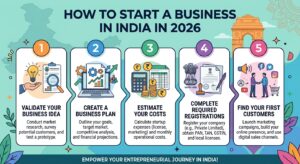
Before choosing from the 12 Unique Business Ideas in India, it is useful to follow a simple validation process.
Validate Your Business Idea
Do not begin by purchasing large amounts of inventory or equipment. Talk to potential customers, test a small version of the product or service, and collect feedback.
The objective is to find evidence that customers have a problem and are willing to consider your solution.
Create a Business Plan
A basic plan should describe your target customers, product or service, pricing, competitors, operating process, marketing strategy, expected costs, and funding requirements.
The plan does not have to be complicated. Its purpose is to help you understand how the business will actually operate.
Estimate Your Costs
Calculate both one-time and recurring costs. Consider equipment, rent, software, inventory, transportation, packaging, salaries, marketing, professional services, and regulatory expenses where applicable.
Complete Required Registrations
The registrations you need depend on the business activity. Udyam is the official MSME registration system, while food businesses have applicable FSSAI registration or licensing requirements. Do not assume that every business requires the same registrations.
Find Your First Customers
Start with a clearly defined customer group. Direct outreach, local networking, referrals, online channels, partnerships, and other appropriate methods can help you reach initial customers.
Your first objective should be learning what customers value and improving your offer before attempting rapid expansion.
Read more: Techehla com 2026: Latest Information, Review, and Updates
Common Mistakes to Avoid When Starting a Business
Starting Without Market Research
An interesting idea does not automatically create a successful business. Research customers and competitors before committing significant money.
Underestimating Costs
New entrepreneurs may focus on the initial purchase of equipment or inventory while overlooking recurring expenses. Prepare a realistic cash-flow estimate and allow room for unexpected costs.
Ignoring Competition
Competitors can reveal how customers are currently being served. Study their pricing, positioning, customer reviews, service quality, product range, and weaknesses.
Making Unrealistic Profit Expectations
No business idea guarantees a particular income. Revenue and profit depend on factors such as customer acquisition, pricing, operating costs, competition, efficiency, taxes, and demand.
Expanding Too Quickly
Growth should follow evidence. First establish that your business can consistently deliver its product or service, acquire customers, and manage its costs.
Final Verdict
The 12 Unique Business Ideas in India discussed in this blog cover a wide range of business models, from digital services and specialized products to food-waste solutions, education, tourism, renewable energy, electronics, recycling, and e-commerce.
The strongest approach is not to select an idea simply because it sounds profitable. Instead, start with a real customer problem, validate demand, calculate costs, understand competition, and check the applicable regulations.
India’s substantial MSME ecosystem and official entrepreneurship resources provide a useful foundation for people exploring new business models. Government resources also identify areas such as food waste, education, waste management, energy, and skilled workforce development as areas where entrepreneurs can consider solutions.
FAQs 12 Unique Business Ideas in India
What are some unique business ideas in India in 2026?
The 12 Unique Business Ideas in India covered here include digital marketing, eco-friendly packaging, food-waste management, tutoring, pet care, solar services, recycling, and niche e-commerce.
Which business ideas require less initial investment?
Service-based businesses such as digital marketing, tutoring, and consulting may require less infrastructure than inventory-based businesses. However, startup costs vary depending on location, tools, skills, business model, and scale.
Can I start a business from home in India?
Yes, some businesses such as digital services, tutoring, customized products, and eligible food businesses can operate from home. However, applicable registrations, licenses, and local requirements may still apply.
How do I choose the right business idea?
Consider your skills, budget, local demand, competition, target customers, and legal requirements before choosing an idea. The best option among the 12 Unique Business Ideas in India is one that solves a genuine customer need.
What registrations may a new business need?
Registration requirements depend on the business structure, industry, and activities involved. Depending on the business, requirements may include MSME, tax, food-safety, local, environmental, or sector-specific registrations.